Want 6-Pack Abs? You’ve Come to the Wrong Place
There are so many ways to strengthen your abdominals. You can do it standing, sitting in a chair, and -- perhaps more obviously -- down on the ground. Today's tutorial requires that you are able to get down on the ground, as well as spend time on hands and knees. And if that doesn't work for you, reply to this email! We can discuss other ways to strengthen your core while standing or sitting in a chair!
From anxiety to awareness—my journey 🌸
It may surprise you that I used to be a pessimist. I also suffered from crippling anxiety. I started therapy and began taking medication. Both helped tremendously.
But the icing on the cake was starting to practice yoga. The year was 2015. Moving my body, learning how to meditate, and practicing calming breathing techniques all worked together to help me deal with fear, dread, and anxiety in a muchcalmer way. Yes, I sometimes still tend to think the worst is going to happen in a given situation (welcome to being an American these days.) And yes, I can worry with the best of them.
Buttttttt, I catch myself now.
This is key! Yoga has helped me not get stuck in those fearful thoughts or worries.
These days it's hard not to be pessimistic. And I'm not suggesting we all have "no bad days" or look at the world through rose-colored glasses. But rather than throw in the towel and give up, my brain now does a better job of acknowledging the bad and then tackling the things I can reasonably tackle. All while acknowledging and embracing the joy that is all around me.
When I start going down the worrying path, it's always because of something that might happen in the future. It has taken years, but I am finally getting good at pausing those worries and asking myself, "Is this situation beyond my control?" If it is, I truly try to let go of the worrisome thoughts. I return to the present moment over and over and over again.
The practice of yoga helps me practice a better attitude towards life.
If you can relate to being a worrier or a pessimist, I'd love to introduce you to yoga. I can teach you gentle movements taken in a chair or on the ground, lead you through a guided meditation, and demonstrate various breathing techniques. All of these can truly help you remain present, embrace joy, and take doable actions to improve your life and the lives of others.
Finding Equilibrium (plus a tutorial for you!)
I recently participated in a team-teaching workshop with my yoga teacher group. The focus was on balance poses and was selected to teach Tree Pose — one of my favorites!
I’ve been teaching this pose for many years, but thought I’d do a little research before the workshop to ensure I had the latest and greatest information. Came across this quote and wanted to share it with you.
“Stiffer trees are more likely to be felled in a storm; the trees that can bend in the wind are less prone to breaking. I love to remember this in Vrksasana (Tree Pose). A little sway from side to side is a sign of resilience and an opportunity to find equilibrium in the middle of shifting circumstances.”
Below is a video for a pose that I call Dancing Tree. Take your time and enjoy working on your balance, ankle mobility, and ankle strength all at once!
Apana Mudra
Mudras are yoga for your hands. This week I introduce Apana Mudra, also known as the Energy Mudra. It can be helpful with elimination, grounding, release, and letting go. It is also practiced when we want to visualize things more clearly. Personally, I practice this mudra when I'm anxious (so pretty much every time I read the news.) The next time you'd like to add a little more calm to your life -- or are making future plans -- sit for a few moments (or minutes) with both hands in the below position, resting on your knees or thighs. I hope it helps.
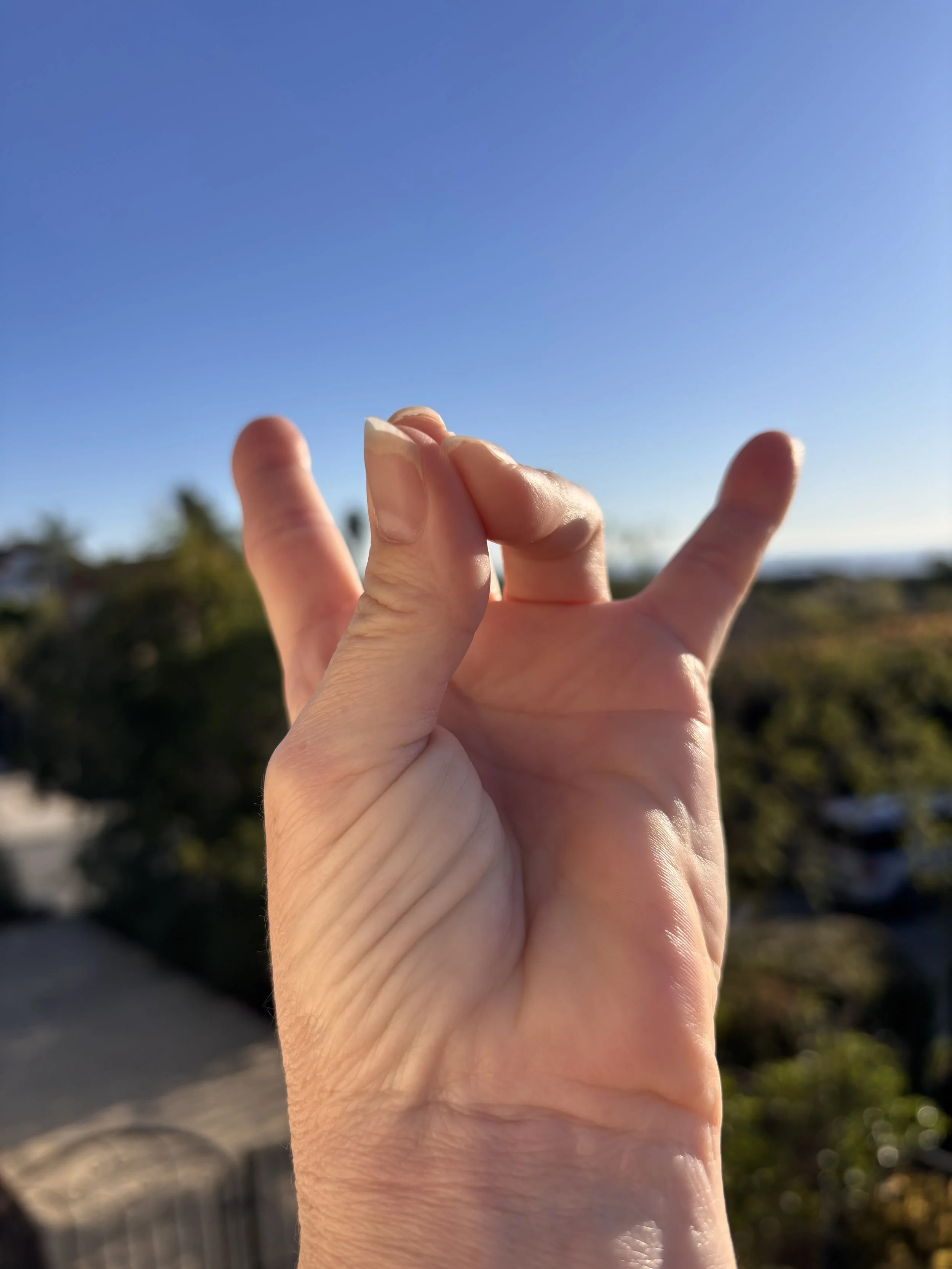
Place the thumb, middle, and ring fingers together. Other fingers are extended.
from the book Mudras: Yoga In Your Hands by Gertrud Hirschi
My Parents’ Homemade Gym Equipment Had Me Cracking Up
I live in Southern California. My parents (ages 90 and 79) live in New Jersey. Thanks to technology, we do our best to meet about once a week for a 30-minute online yoga session. I usually have three goals for our session together:
Move their spines in all directions, as well as stretch their necks, shoulders, and hips for better mobility
Challenge their proprioception (awareness of their bodies in space) to help prevent falls
Help them get stronger (to help with chronic pain, as well as better balance)
It is always a hoot to see what items they bring to the strength portion of their sessions. Here's what they brought recently:
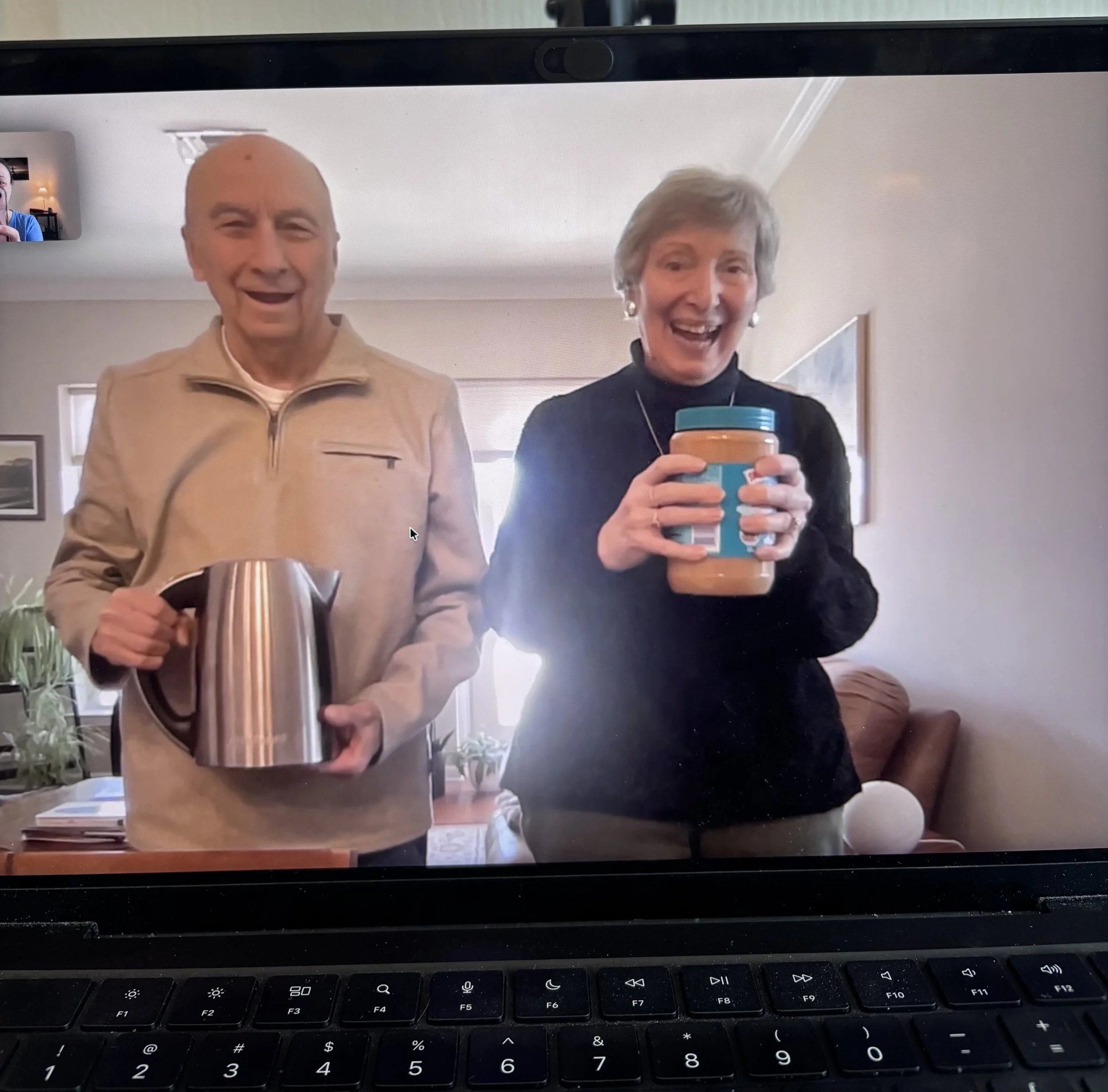
My parents during an online strength and yoga session
Is there an older adult in your life who could benefit from some stretching, strengthening, and maybe listening to a guided meditation for calming? Contact me at the address or phone number at the bottom of the page!