Yoga for Brain Health -- Part Two (Quality Sleep)
Whether you have gone through menopause, have a high-stress job, are an anxious person, or are a parent (or all of the above!), quality sleep is often elusive. Some folks have difficulty falling asleep (hello brain that loves to worry). Some awaken frequently during the night (why do our bladders seem to shrink as we age?). And some “lucky” folks experience both. If you see yourself in any of the above descriptions, keep reading.
Yoga has eight limbs (or branches). The limb most people are familiar with is asana, or yoga postures. These are the movements you take in a yoga class (e.g., mountain pose, the warrior series, balance poses.) Like most forms of exercise, mindfully moving through a variety of yoga postures is a wonderful way to prepare the body for sleep. If you’d like to quietly move your body before bed (a terrific idea after sitting all day or when feeling agitated), try this seven-minute sequence. These movements can be done in bed — does it get any better than that?
If you’d like to warm up your body before a workout — or perhaps let it serve as your workout — here’s a five minute standing sequence for you. While you could do this in the evening, I prefer these movements earlier in the day. Prefer to stay seated during a yoga sesh? Try this 15 minute video. All of these videos get your body moving, allow you to s-t-r-e-t-c-h, help you release some tension, and just might help you sleep better.
A second recognizable limb of yoga is pranayama, or breathing techniques. Thankfully, modern medicine is now learning what yogis have known for centuries: that manipulating the breath can have a powerful effect on the mind — and that effect is almost always calming. Easier to fall asleep when you’re calm, no? There are a variety of breathing techniques — you can find several tutorials on my YouTube channel.
I invite you to explore the movements of yoga, as well as a variety of breathing techniques. You just might find that you sleep better — and thereby give your brain health a boost.
Yoga for Brain Health -- Part One (Exercise)
Google “pillars of brain health” and different lists appear. This series of blog posts will discuss the five pillars that I focus on in my yoga classes for seniors.
First up is regular exercise. Duh, right? It would be hard to meet a person who thinks exercise is useless. But just because most of us know that it’s good for us, doesn’t meet we all do it! I think people have good intentions: they want to move their bodies; they know they would feel better. But what if you are one of millions of people living with chronic pain that makes movement difficult? Perhaps you had a joint replacement recently and are hesitant to do anything too vigorous. Maybe you’ve led a rather sedentary life and don’t know where to begin.
Before you do anything, talk to your healthcare provider. Are there certain movements that you should avoid? Have you been screened for osteoporosis? Did you complete your last round of physical therapy exercises and have been cleared to resume exercise? These are important questions to ask before embarking on any new movement regimen.
Once you’ve got the green light, try a yoga class made for your needs. Gentle yoga is a fabulous way to gain greater body awareness, stretch out those tight areas, strengthen a bit, and maybe even raise your heart rate a little. However, if you are one of the folks mentioned above, I do not recommend popping into just any yoga studio. Most yoga classes geared for young, bendy bodies. Call the studios near you or stop by and talk to someone who can explain what goes on in each class. Ask if the instructors can customize yoga poses for various ailments or physical limitations. Ask for details about the instructors’ trainings. Just because a yoga instructor has some fancy letters and numbers after their name, doesn’t mean that they are adept at working with folks with special needs! (I am one of those teachers who has an extensive background in anatomy as it relates to yoga and can come up with a customization of just about every yoga pose.)
If you feel comfortable trying a group class, have a few yoga props nearby to help you make the most of the class. Most studios will have a variety of props such as yoga blocks, straps, and blankets that you can borrow. Or you can purchase them pretty inexpensively at stores like Target and Marshalls.
When class begins, resist the temptation to look around at other students. Everyone is on a different part of their yoga journey! Some folks’ yoga poses will look much different that yours — at least at first!
You’re welcome to give all of the yoga poses a try, but stop attempting a yoga pose if it doesn’t feel right for your body. If the class is small, you can flag down the teacher and see if they can come to your mat and offer guidance. A good teacher will also respect a student’s decision to skip a pose. Honoring your body is much more important that doing something just because the yoga teacher says so!
As one of my first yoga teachers Gretchen Schutte said, all you really have to do during a yoga class is breathe. Yoga poses are great. But if you are having a day where one or move yoga movements isn’t suiting you, you have full permission to sit or lie down and breathe. Resting and breathing can be one of the most important parts of a yoga practice.
Yoga isn’t the most cardiovascular form of exercise — and you certainly won’t win any bodybuilding competitions. But it is a terrific way for people new to exercise or who are living with a range of physical challenges to feel better in their bodies — and help their brain health.
Luck of the Irish
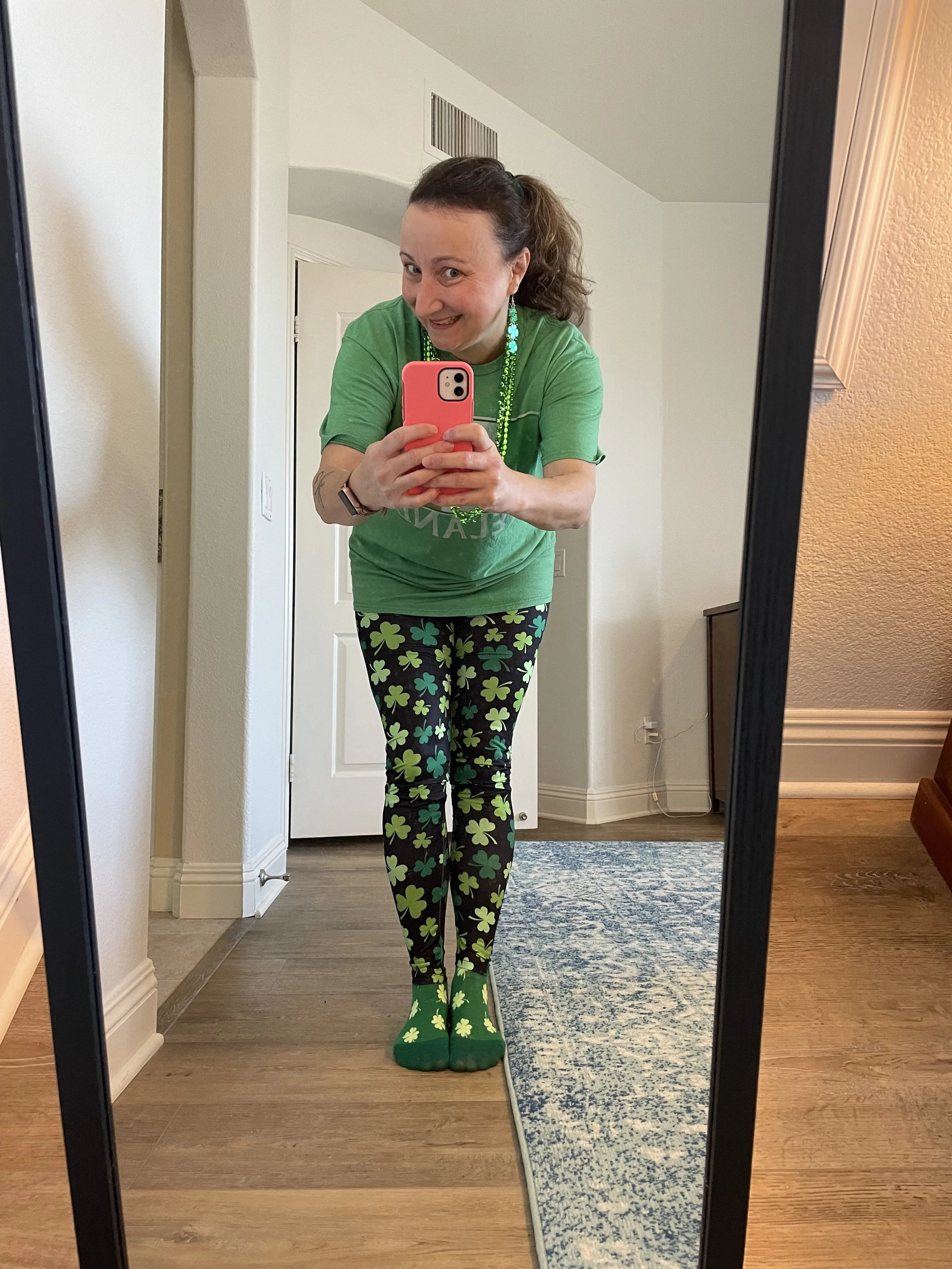
I'm 75% Italian. But I'm also 25% IRISH! So you know I had St. Patrick's Day-themed yoga classes this week! We did rainbow breathing for calming, took Surfing Leprechaun pose to challenge our balance, played an imaginary harp to get some blood flowing to our fingers and hands, tossed coins into the Pot o’ Gold, and even did an Irish jig! In one memory care class, folks enjoyed singing "My Wild Irish Rose" (this was my Irish grandmother's favorite tune).
While I don’t have a theme for every yoga class I teach, it sure is fun when there is one. Often the themes coincide with a national holiday. But sometimes I connect them to the seasons or popular places to visit (e.g., the beach or the mountains). Whatever the case, you can be sure I will be dressed-up, have a fun music playlist, and lots of silliness woven in!
Where's My Pelvis?
This week I've got a *30 second video* introducing you to your pelvis! I'm 52-years-old and have birthed four children, yet I had minimal pelvic awareness when I did my first yoga teacher training back in 2016! Your pelvis holds so many important organs, is the starting point of your spine, and is one of the most stable parts of the body!
Check out this super-short video and let me know what you learn!
Hope you can take a little time to notice what's going on in your body this week!
Happy Hips
Do you enjoy going for a walk?
Maybe you're an avid hiker or runner. Or perhaps your hips just feel tight a lot of the time (hello Zoom calls that seem to last forevvvvvvver.)
If you relate to any of the above, your hips could benefit from some rotation. Circling the femur (hip) bone in the hip socket is an important movement for good hip mobility. Kate -- one of my dedicated students -- takes the below movement after every walk or hike. She has noticed a marked improvement in her hip pain as a result!
Click below and see if your hips are a little bit happier afterwards!